KOSHER RECIPES FOR GLUTEN-FREE LIVING


Sunday, March 08, 2009

It's Time for Another Gluten-Free Purim! Hamantaschen, Mishloach Manos and More...


As usual, I am posting a holiday roundup just a day or two before the holiday. Oy, I am such a procrastinator. Hopefully this will still come in handy for some of you. I notice I'm getting a huge number of hits for "gluten-free hamentaschen" / hamentashen, hamantashen, etc. So I thought I'd make it easier for you to find my Purim-related postings as well as some postings by some other blogs.


If you're looking for gluten-free hamantashen recipes:

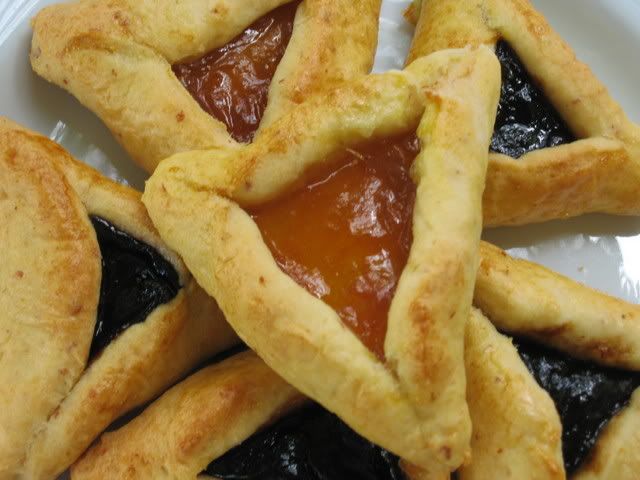
My recipe for Gluten-Free Hamantaschen made with no-refined sugar. I love this recipe and am sad I haven't had the chance to make it this year. I've gotten very good feedback on this recipe - If you try it please let me know how it works for you!

Elana's Pantry has a vegan, refined-sugar-free, grain-free recipe for Gluten-Free Raspberry Hamantaschen that you might be interested in if you have multiple food restrictions.

Or maybe you'd like to try an Adaptation of a Chabad Recipe for Gluten-Free Hamantaschen.

About.com also offers a recipe.


If you'd like to order gluten-free hamantaschen online:

Heaven's Mills Gluten-Free Hamantashen

Katz Gluten-Free Raspberry Hamantaschen (I ate these today!)


If you're looking for ideas for gluten-free mishloach manos:


My list of ideas for creative gluten-free mishloach manos can be found here. Think outside the box!


If you're a Jew with food allergies or intolerances and/or celiac disease:


Consider joining the AllergicJews listserv, on which other Jewish (kosher and non-kosher) folks with food restrictions share recipes, ideas and resources.

CHAG PURIM!

Wednesday, December 31, 2008

Moroccan Cauliflower Recipe + A "Specific Carbohydrate Diet" Cookbook Review


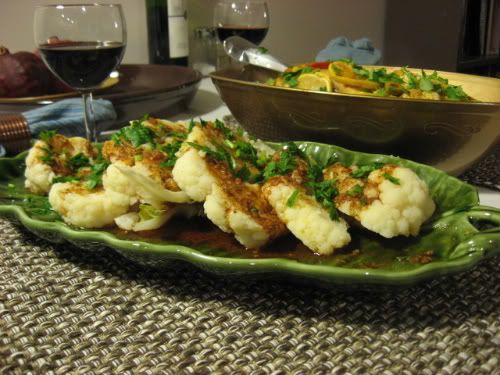
[Photo: My New Year's Eve Dinner Table]

We decided to spend a relaxed New Year's Eve at home, with a movie, a bottle of wine, and a home-cooked Moroccan feast for two. What better opportunity to crack open some cookbooks I haven't yet used? Seeing as my partner has re-started the South Beach Diet and I'm doing my own low-glycemic food thang, the first book I went to was Eat Well Feel Well by Kendall Conrad. This is a book of recipes that comply with the Specific Carbohydrate Diet.

One of the perks of being a food blogger is having publishers send you new cookbooks to look at. Unfortunately I am way behind on cookbook reviews, so many months after receiving this book from Clarkson Potter Publishers, I'm finally getting around to using it, perusing it, and sharing my feedback here. I was won over by the beautiful color photographs in the center of the book. I must admit I have a serious aversion to cookbooks that don't have full-color photos, so the photo section of this book was a real plus. The Specific Carbohydrate Diet is used to treat sensitive tummies as well as guts that have been damaged by Crohn's disease, ulcerative colitis, celiac disease, irritable bowel syndrome, diverticulities, etc. Celiacs and gluten intolerant folks who eat a strictly gluten-free diet usually find that their guts eventually heal and are generally able to tolerate any non-gluten foods after the healing period is over. However, many of us have multiple food allergies or other digestive disorders. Others find that they continue to be sensitive to a variety of foods and have trouble with digestion long after they are gluten-free, due to damage to their digestive tract. A small number of people find that they simply cannot digest grains at all, and that non-gluten grains make them almost as ill as gluten-containing grains. This cookbook is based on the diet described in the book Breaking the Vicious Cycle: Intestinal Healing Through Diet by Elaine Gottschall, which is the bible of the Specific Carbohydrate Diet (SCD). The diet eliminates "virtually all starch and complex sugars" and features a balance of "smart carbohydrates, good proteins and fats, and essential vitamins and minerals." It is grain-free. No unfermented / un-aged dairy products are allowed so the diet is lighter on dairy than most. This way of eating has helped many people recover from life-threatening digestive disorders.

The difficulty of digesting grains has been explored in other books over the years, such as Against the Grain by Melissa Smith. I don't personally feel a need to eat this way, but many if not most of these recipes are also low-glycemic and low-carbohydrate and therefore fit well into my household's meal plans. Best of all they don't reflect deprivation, but rather an enjoyment of the plentiful healthy gut-friendly foods available at the farmer's market or grocery store. There are grain-free recipes for everything from grain-free Cashew Butter Tortillas to Peach Pocket Pies, and from Shepherd's Pie with Mashed Cauliflower to Tom Yum Kai with Coconut Milk & Lemongrass Infusion.

Tonight I tried my first recipe from the book, which was Moroccan Cauliflower. While it was the photo that first caught my eye, I was also intrigued by the unusual (or at least new to me) method used for cooking cauliflower. Although my favorite method for cooking cauliflower is roasting it, I think this will be my new cauliflower technique for when times is short or I'm trying to reduce the fat in a dish. By steaming the entire head of cauliflower without cutting it first, it avoids all the wasted little cauliflower bits that litter the cutting board when you try to cut a raw cauliflower into florets, because it's far easier and neater to slice a whole head of cauliflower when it's cooked. The presentation of this dish is lovely, and it might even convince one of those notorious cauliflower haters to reconsider.

Here is my adaptation of the recipe from Eat Well Feel Well. I hope you enjoy it, and have a fabulous, healthy and safe New Year!


MOROCCAN CAULIFLOWER

Adapted from Eat Well Feel Well by Kendall Conrad.


[ Gluten-Free / Dairy-Free / Pareve / Vegan / Soy-Free ]

1 medium head cauliflower
1 tsp paprika
1 tsp ground cumin
1/8 tsp ground cinnamon
1/4 tsp ground ginger
1/4 cup extra-virgin olive oil
2 Tbsp freshly squeezed lemon juice
2 cloves garlic, crushed (use frozen garlic if raw garlic is too sharp for you)
1 tsp fine sea salt or table salt
1 tsp freshly ground black pepper
1/4 cup chopped flat-leaf parsley

Trim the stalk of the cauliflower to the base, removing all leaves except the smaller green leaves closest to the head. Fill a pot with half an inch of water, place whole head of cauliflower in it (stem side down), and cover with a lid. Simmer on medium heat for 10-20 minutes (will vary depending on size of head, I had to simmer a medium head for about 15) until the desired tenderness. Remove from pot immediately, transferring to a cutting board or serving platter.

While cooking the cauliflower, whisk together the oil, lemon juice, garlic, salt and pepper. Lightly toast the ginger, paprika, cumin and cinnamon over medium-low heat in a small pan for 3-5 minutes or until fragrant. Remove from heat and whisk into the liquid mixture, combining thoroughly.

Cut the cauliflower in 1/2-inch thick slices, transfer to a serving platter and drizzle all of the spiced oil over the slices. Sprinkle with the chopped parsley and serve hot or warm.

OTHER CAULIFLOWER RECIPES:

NOTE: Some of the links in this post are affiliate links, which means if you click through the link and purchase something from the site I will receive a small commission that helps me pay for the costs incurred from running this website.

Sunday, December 21, 2008

Gluten-Free Chanukah Recipe Roundup: Latkes, Sufganiot (Jelly Donuts) and More!


Are you looking for gluten-free Chanukah recipes? You can see last year's Chanukah recipe roundup here. I thought I'd do an updated roundup with some links to a bunch of gluten-free Chanukah recipes to help you enjoy a delicious holiday. Some are mine and some are other folks' recipes. Chanukah foods are traditionally fried in oil and/or contain dairy, but there are as many different variations as there are ways to spell Chanukah / Hannukah / Hanukkah / Hanuka. I've tried to provide links that are varied enough that most folks can find something they'll be able to eat and will enjoy. Chanukah sameach!


GLUTEN-FREE LATKES

Sweet Potato & Leek Latkes
Confetti Latkes (Carrot & Parsnip with Chives)
Traditional Potato Latkes
Potato Latke Recipe from Kosher Celiac Cookery
Karina's Potato Latkes
Zucchini Latkes
Vegan Broccoli Latkes
Karina's Vegan Sweet Potato Latkes
Cauliflower Latkes (use soy flour option)

TOPPINGS FOR YOUR LATKES

Cranberry-Applesauce & Traditional Applesauce
Vegan/Pareve Cashew Sour Cream
Apple Salsa, Honeyed Yogurt and More
Wasabi Scallion Sauce
Dill Sour Cream

GLUTEN-FREE SUFGANIYOT / SUFGANIOT / JELLY DONUTS

Gluten-Free Jelly Donuts / Sufganiyot
Low-Carb Donut Recipe from About.com

OTHER CHANUKAH TREATS

Chocolate-Dipped Apricot "Gelt"
Leek Fritters (Prassokoftedes)
Gluten-Free Noodle Kugel with Cranberries
Chanukah Cookies
Lamb & Leek Koftas
Beet, Cabbage & Mushroom Borscht
Fried Chickpeas
Fried Mozzarella Sticks

Remember you can always find my Jewish holiday recipes by clicking here or on the "Jewish recipes" tag on the sidebar at left.

HAPPY CHANUKAH!

Sunday, November 30, 2008

Adopt A Gluten-Free Blogger: Karina's Pumpkin Chai Bread with Cranberries


Seamaiden of the vegetarian gluten-free blog Book of Yum is hosting another round of Adopt a Gluten-Free Blogger, a blogging event in which we adopt another GF blogger and prepare one of their recipes. Last time I participated in this event, I baked gluten-free pita bread. This time it's the "Thanksgiving Edition" so we were all asked to prepare a dish from another blog that was thematically appropriate. I chose to prepare the vegan, gluten-free Pumpkin Chai Bread with Cranberries from the blog Karina's Kitchen (a/k/a The Gluten-Free Goddess). Karina has long been one of my favorite bloggers. She has supported and inspired me ever since I entered the blogging world several years back. When she got diagnosed with a huge list of food allergies in addition to celiac disease, the gluten-free blogging showed their support for her in the Cooking for Karina event I hosted. They made it clear with their numerous submissions that she is one of the best-loved residents of the gluten-free (and food allergy) blogosphere. But I have to make an embarrassing confession: Though I've used Karina's recipes often to inspire my own cooking, I don't think I've ever truly and thoroughly followed one of her recipes! Until today, that is. I chose this recipe in order to use up the cranberries left over from canning cranberry applesauce a few weeks ago and to stretch myself by actually following a recipe for a change.

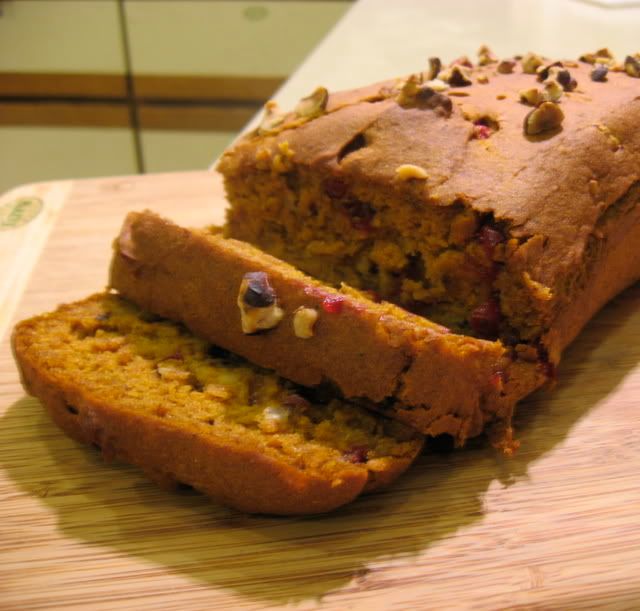
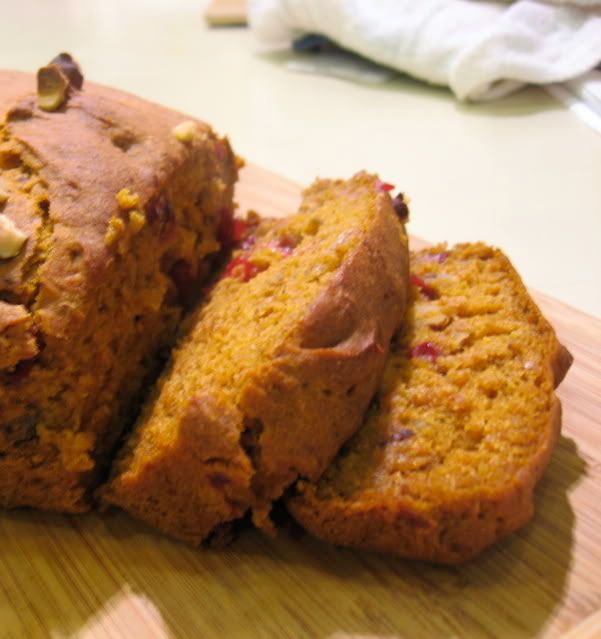
I was a little worried about what the texture would be like, because the recipe is eggless and I haven't done a whole lot of vegan baking since being gluten-free. Thanks to egg replacer and xanthan gum it actually holds together pretty well. It is beautiful when it comes out of the oven - It is golden in hue and the cranberries look like gems! I enjoyed it, and look forward to toasting a slice or two for breakfast in the morning. Do I lose points if I smear a little butter on your vegan recipe, Karina? Hehe.

The down-low on how I customized the recipe: I chose to use chopped hazelnuts as a mix-in in addition to cranberries, as they were on sale at the store (I initially wanted pecans, but they were twice as expensive). That was a good choice, because the ones I sprinkled on the top of the loaf before baking became lightly toasted which brought out their flavor and crunch. I used raw agave nectar instead of sugar (per Karina's suggested measurements). I would probably use a good bit more sweetener next time. I don't have a major sweet tooth but I think a little more sweetness would round out the flavor. I'd also cut down on the liquid a little bit more than I did, to compensate for the moisture from the agave. I baked it for 60+ minutes and it was still a bit too moist inside. The flours I used were 3/4 cup of millet flour, 1/2 cup sorghum flour, and 1/4 cup tapioca flour.

This bread has a really nice texture with little bursts of tart cranberry flavor. It is lightly sweet which is great for those of us who don't have huge sweet tooths or are trying to cut back on sugar. It has a subtle chai flavor and the pumpkin is present but not overly assertive so this might be a way to get some more veggies into your kids' tummies! It's easy to make successfully using mostly whole grains, which was a plus.

If you haven't checked out Karina's Kitchen, you've been missing out. It's worth subscribing to Karina's blog for the photographs alone! Stop by and congratulate her for just publishing Aftertaste in Exile, her book of paintings, poetry and photography.

Sunday, September 14, 2008

Glutenfreebay.com is on Facebook!

gluten-free facebook

Did you know that you can connect with me, with this blog, and with other Gluten-Free Bay readers via the wonderful world of Facebook? So, come join in the fun!

You can declare yourself a fan of Gluten-Free Bay here which will allow you to talk with other Gluten-Free Bay readers as well as have a pretty little picture and link show up on your profile if you so choose. This is a great way to show your friends what blogs you're a fan of.

You can also join Gluten-Free Bay's blog network here. Soon people who join my blog network will be able to see my new posts right on Facebook.

I would be thrilled to connect with more of you via Facebook, so if you're on there, let me know who you are by following one of the links above.

The Quest for the Best Gluten-Free Cholent

rival crock-pot versaware pro crockpot slow-cooker

This shabbos, I finally found one of the holy grails of kosher gluten-free cooking - A fantastic gluten-free cholent. I crafted this Ashkenazi/Sephardi fusion cholent by accident, really. Cholent is a stew that cooks slowly in a crockpot during Shabbos (the Jewish sabbath, during which observant Jews do not light or extinguish fires or electricity) without being stirred or having the heat adjusted in any way. It's the ultimate in low-maintenance cooking, since you just add a bunch of ingredients to the crockpot and let them cook overnight with no interference. People who've never tried slow cooking in a crockpot might think that all the ingredients would be mush after so much cooking - Strangely enough, vegetables tend to retain their shape and stay fairly firm during crockpot cooking. The meat, which should preferably be from a tougher cut (tough cuts do best with slow cooking in liquid), will become deliciously tender and fall apart when you stick your fork into it. Ashkenazi cholent is usually made with barley or wheat berries, neither of which people with celiac disease or gluten intolerance can eat. But you won't miss the grains with this cholent, as it's unbelievably flavorful and has a variety of textures.

The Sephardi influence on this dish is the use of spices and flavorings that you wouldn't normally find in an Ashkenazi cholent (paprika, lots of garlic, turmeric), as well as the optional addition of whole in-the-shell eggs which become hardboiled over the course of the slow-cooking process. This is a little more decadent and a little more healthy than your average cholent. It wouldn't be an exaggeration to say that this dish has completely changed my conception of cholent. It's heavy but doesn't sit in your stomach like a rock, as some cholent does. My partner is a cholent-eating afficionado and she gave this one two thumbs up.

I sauteed the meat to brown it about 1/2 hour before candlelighting on Friday (a little before 7) and then transferred it, along with all the other ingredients, to the crockpot. My crockpot (pictured above) automatically switches to its warm setting as soon as the cooking time you set it for is done - So at about 7 in the morning on Saturday it switched over, and we ate it at 12:30 PM. It was hot, and perfectly cooked. We ate the leftovers for lunch today and my partner mentioned that this was the first time she'd had the desire to eat leftover cholent. But then again, this is no ordinary cholent!

A little disclaimer: I call for "powdered gluten-free onion soup, vegetable or chicken soup mix." Most kosher soup mixes have MSG in them. That's part of what makes them so tasty. I generally refuse to purchase or consume anything with MSG. But this is my exception. It's my little vice, I guess. If you must avoid MSG at all costs, you can use a couple of gluten-free MSG-free bouillon cubes instead. I've found a kosher, gluten-free brand called Bloch's Best that has no MSG. It's imported from Europe - I found it at Natural Spot in Teaneck. They won't be quite as flavorful as the mixes with MSG, so if you like you can use more salt and more spices and a little more white wine to make up for it.

If you don't have a slow-cooker you can still make this dish - Bring the ingredients to a boil, reduce to a simmer, then right before shabbos cover the pot very tightly and either simmer over a low flame all night, or have it cook in the oven on a low setting.

I will be happy if thise recipe helps just one other gluten-free Jew have more joyful and delicious shabbos... and even happier if some non-Jews and/or non-celiacs will discover this as a new way to prepare a filling one-pot meal.

GLUTEN-FREE CROCKPOT
CHOLENT / HAMIN


A Slow-Cooked Meat & Bean Stew for Shabbos and Every Day

[ Gluten-Free / Dairy-Free / Soy-Free ]

1 Tbsp vegetable oil
1 lb to 1 1/2 lbs cholent meat / stew beef
1 onion cut into chunks
2 cups dry cholent bean mix or any combination of pinto beans, cranberry beans, white beans and/or kidney beans
3 Tbsp powdered gluten-free onion soup, vegetable or chicken soup mix*
1 or 2 carrots cut into 1" slices
5 medium yukon gold potatoes, unpeeled, cut in half
2 large sweet potatoes, peeled, cut in quarters
1 cup sliced white mushrooms
5-10 cloves of garlic, chopped roughly or sliced
1 tsp turmeric
2 tsp smoked paprika
2 bay leaves
1 tsp salt
1 tsp ground black pepper
Optional: Generous dash of white wine
Optional: 2-4 uncooked eggs in their shells

[*I use Osem's pareve, vegetarian, kosher-for-Passover "Chicken Style Consomme Instant Soup & Seasoning Mix" which is gluten-free. I purchase it at Passover to last me year-round since the rest of the year their formula includes gluten.]


In a pan, or in the ceramic liner of your crockpot (if it's the type that can be removed from the element and used like a pot on the stove) heat 1 Tbsp vegetable oil over medium heat. Add onions and sautee for 2-3 minutes. Add meat and cook only until browned on the outside. Move onion and meat mixture into the crockpot (or move your ceramic liner back onto the heating element of the crockpot). Set it so that it will cook on low for 12 hours and then switch to its warm setting.

Add dry (unsoaked) beans, then potatoes. Add all of the rest of the ingredients except for the eggs, distributing ingredients as evenly as possible. Make sure the meat won't touch the lid of the crockpot. Nestle eggs carefully on top of other ingredients. Pour water into the crockpot until it covers everything. Put the lid on, making sure it fits securely so that steam doesn't escape (use a layer of tin foil underneath if necessary).

Do not stir the cholent until you are ready to eat it, at which point you can remove the eggs so that you don't crack their shells, and stir it VERY gently.

Serve in bowls, topped with the now-hardboiled eggs (if you included them). If you've warmed your favorite gluten-free bread or challah on the top of the crockpot you can use it to sop up the stew.

NOTE: This recipe is for a 6-quart crockpot. For a smaller crockpot, reduce all the quantities slightly. No exact measurements are necessary for this recipe.
Friday, July 18, 2008

Cabbage Salad with Lime and Fresh Oregano, and a side of Big News!


Our new apartment is coming together slowly but surely. Merging two people and all their respective stuff into one apartment and a shared life is quite a project. I am loving living in a spacious apartment with hardwood floors and walls painted lovely colors. I am also really digging the endless cabinet and counter space in our new kitchen (still unpainted and far from ready for a photo op!) New Jersey life is treating me pretty well, considering how ill-suited I am to suburbia.

I have a piece of news that I am sharing with some butterflies in my stomach:

I got accepted to the school I applied to, to become a Nutrition & Food Science major with a concentration in Dietetics! It's an ADA-approved program to set me on track to becoming, G-d willing, a Registered Dietitian. I am pretty darn scared but also very excited. Gonna be a full-time student for the first time in many years. It'll be an intense few years 'til I finish my degree, let me tell you. Anatomy & physiology, organic chemistry and microbiology, oh my.

It was 96 degrees today and our air conditioner is/was broken. It's been repaired but is taking a long time to get our second-floor-and-right-above-a-pizza-place apartment back to a bearable temperature. So I decided to do minimal cooking.

It's hot, my back hurts, and my partner is on the South Beach Diet. So this is tonight's menu for a laid-back shabbos (sabbath) for just the two of us:
  • Ground turkey tacos on corn tortillas, with black beans, homemade salsa fresca, fresh guacamole and dairy-free/pareve sour cream (Tofutti, since there's no time to make it from scratch).
  • A delicious looking Rioja wine from the fantastic kosher wine section at the ShopRite liquor store in Englewood.
  • Cabbage salad made from the hugest cabbage I've ever seen.
  • Sugar-free ice pops.
Nothing fancy. For tomorrow's lunch we'll have salad with quinoa topped with roasted beets and carrots, and some feta cheese.

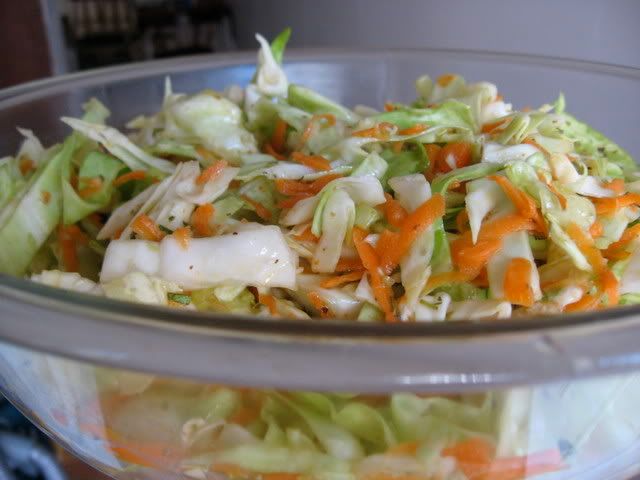
Here's a recipe for the cabbage salad I made. It's a quick, light, no-cooking recipe with lots of flavor. A great crunchy topping for tacos or a side dish for any meal, especially a spicy summer meal. It's not so different from the curtido de repollo I posted as a topping for homemade pupusas, but I made some alterations that give it its own crunchy identity. Like most cabbage salads, it should get tastier by the day so I made enough that my partner will be able to take some with her to work on Monday for lunch.


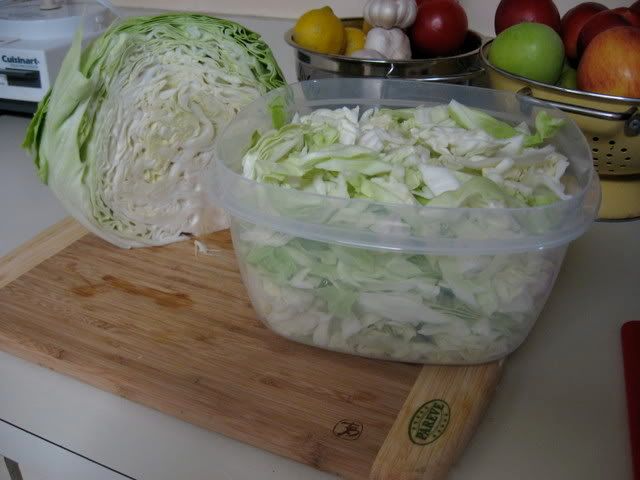
The picture above is of the cabbage I used, which is the biggest cabbage I've ever seen. I picked up for $1.50 at the Englewood Farmer's Market today from a local farmer. Good grief, this thing is huge! I don't know if the picture really conveys its hugeness, but I took this pic to show how half the cabbage filled up the biggest, gigantic-est tupperware we have. It was about twice the size of my head, and will easily feed us for two weeks. To be realistic, I've called for one medium cabbage in this recipe, even though in my case it was really 1/2 a mutant cabbage.


Enjoy! Gut shabbos.

CABBAGE SALAD WITH LIME AND FRESH OREGANO

[Gluten-Free / Dairy-Free / Pareve / Vegan / Soy-Free ]

1 medium cabbage, shredded or chopped into small pieces
3-4 carrots, shredded
2-3 Tbsp fresh oregano leaves
1/2 tsp salt
1/2 tsp cumin
1/4 tsp cayenne
1/4 tsp ground coriander
1/4 cup extra virgin olive oil
1/4 cup apple cider vinegar
2 limes, juiced
2 tsp agave nectar or honey

Mix all liquid ingredients and spices (except fresh oregano) in a small container. In a large bowl, combine cabbage, carrots, and oregano. Drizzle the liquid/spice combination on top of the vegetables, mixing frequently. Cover and refrigerate for 2-4 hours before serving cold or at room temperature.

Tuesday, June 17, 2008

First harvest.

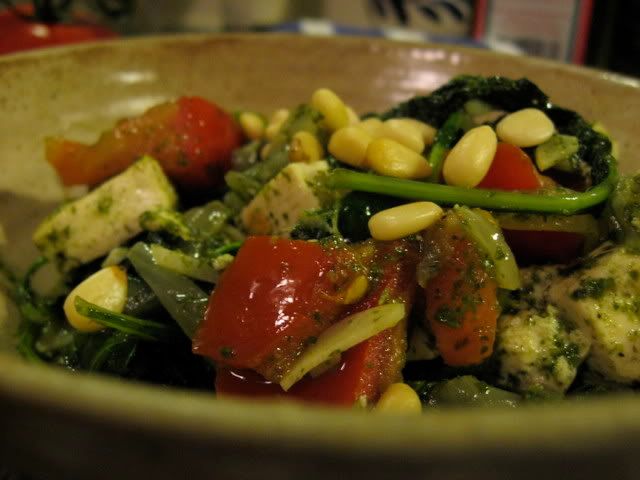
My first harvest from our garden was a huge bag of baby dinosaur (lacinato) kale, which I turned into a big pan of this:


It's tofu, kale and tomatoes with parsley pesto and pine nuts. I will post the recipe at some point, but not at this moment because I'm a bit overwhelmed. I am in the middle of moving... to New Jersey. I am shacking up with my love. More on this later. I will have my own kitchen again - And some free time this summer. A good recipe for more food blogging, perhaps?

What are you cooking with harvest from your own gardens, or from farmers' market bounty?