KOSHER RECIPES FOR GLUTEN-FREE LIVING


Showing posts with label weekend herb blogging. Show all posts

Monday, June 08, 2009

Un-Cooking: Rochel's Purple & Orange Cabbage Salad

On this blog's Facebook fan page I mentioned that I was writing a blog post about a dish that's purple and orange, and I gave people a chance to guess. Mary Frances got it right on the first try, but I loved some of the other ideas - My mom picked "sweet potatoes and eggplant" and another fan picked "blueberry, orange and almond pie," both of which sound quite delicious.

But Mary Frances was right because she knew that since it's almost summer, I must be blogging a cabbage salad... yet again! Summer also means that it's time for more "un-cooking" - Recipes that can be made during hot weather without making your kitchen any hotter than it already is. I've posted before (a million times) about the cabbage salads that we live on all summer long, which are wonderful and crisp when freshly made but just get better and better the longer they sit in the refrigerator absorbing their dressing. The difference with this salad is how beautiful it is to look at - Bright orange and deep purple (my dad's favorite color combination). It brings a splash of color to an otherwise neutral-looking plate. In this case dinner was bean tacos and plantains. I hope the colors will appeal to some of my readers' vegetable-hesitant children.

But this is not my recipe, folks! Nope, I had no part in it. This is the foodblog debut of my wonderful partner Rochel's mad cooking (or in this case un-cooking) skillz. That's her picture over on the right hand side of this post. I made the tacos and fried the plantains, but Rochel insisted on making the cabbage salad herself so this recipe is 100% hers. The only change I made is to mention some optional alterations to the recipe. The spices don't have measurements because you'll need to spice this to suit your own tastes and your family's. Just be sure to make the cumin flavor strong... and don't skimp on the salt, either.

Rochel, you officially win the Prettiest Cabbage Salad Award for 2009. Your reward is flatulence my appreciation for how much of the cooking you've been taking on lately, plus some extra effort on my part to stop being such a kitchen dominatrix. Thanks for gently pushing me to learn how to let someone else into "my" kitchen.

For more easy "un-cooking" recipes for hot weather click here.


ROCHEL'S PURPLE & ORANGE
CABBAGE SALAD


[ Gluten-Free / Dairy-Free / Pareve / Vegan / Soy-Free ]


1/2 of a large head of purple cabbage
1 orange bell pepper
2 carrots, shredded
1/2 to 1 bunch of cilantro, chopped
Juice of 4 limes
1/2 cup extra virgin olive oil
Salt & pepper
Garlic powder
Onion powder
Cumin
Optional: Canned mandarin orange segments or chopped pieces of fresh orange
Optional: Small amount of agave nectar, honey or other sweetener

With a sharp knife, cut 1/2 a purple cabbage into several wedges, then slice thinly across the wedges width-wise. Alternately, if you have a food processor, you can use its shredder function to shred the cabbage. Remove stem and seeds from the orange bell pepper and cut into long, thin slices. Combine cabbage, carrots, pepper and cilantro into a large bowl. Combine spices, lime juice and olive oil in a small bowl and then pour over the salad. Stir gently, making sure all of the vegetables are coated in the dressing.

Serve at room temperature. Stores well in an airtight container in the refrigerator, and increases in flavor over time. Can be refrigerated for up to a week.

This recipe has been posted as part of Weekend Herb Blogging, a weekly blog event hosted this week by Eat This.

Friday, February 22, 2008

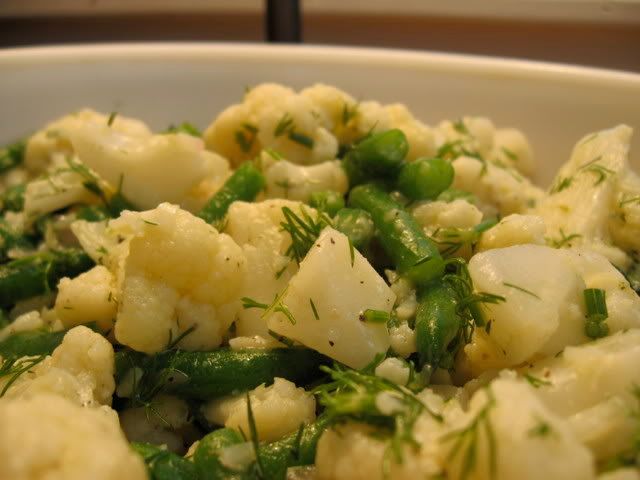
Herbed Cauliflower & Green Bean Salad A/K/A German Potato Salad Without the Potatoes


I've been having quite a hankering for German potato salad - Specifically, my "famous" Herbed New Potato Salad with Green Beans. Unfortunately, potatoes are super high-glycemic and are not considered "good" carbohydrates, and thus are verboten on the South Beach Diet, any low-carbohydrate diet, and the Glycemic Index / low-gylcemic approach to eating. What's a serious potato lover to do? Cauliflower!

I love cauliflower. I always have. Since eating a lower-glycemic diet I've been cooking my Lemon-Roasted Cauliflower with Dill and other roasted cauliflower recipes quite a bit. Another favorite cauliflower dish is my Aloo Gobi Mattar (Indian Potato, Cauliflower & Pea Curry) which I will also try making without potatoes one of these days.

Simply by replacing new potatoes with small florets of cauliflower boiled until tender, I was able to re-make this recipe into something healthier, more nutrient-dense and dramatically lower carbohydrate, without compromising the taste. I loved this salad, and it was even better a day and two days later when the cauliflower and beans had absorbed more of the marinade overnight.

I make a lot of salads and vegetable dishes that can be eaten cold on Shabbos since I don't cook on the sabbath. So I made this Friday to eat with my dinner, but also ate it for part of my lunch on Saturday. Heck, I even ate it for breakfast!

HERBED CAULIFLOWER & GREEN BEAN SALAD

[ Vegan / Dairy-Free / Pareve / Soy-Free / Gluten-Free ]

2 large heads of cauliflower
2 1/2 cups green beans, cut in thirds
2 Tbsp salt
1/4 cup minced fresh chives
3 Tbsp minced fresh dill
3 Tbsp dijon mustard
3 Tbsp apple cider vinegar
1/2 cup extra-virgin olive oil
1 large shallot, minced
1 tsp agave nectar, sugar or equivalent non-sugar sweetener
1 tsp freshly ground black pepper
Optional: Minced fresh flat-leaf parsley to taste

Combine all ingredients except cauliflower and beans in a large bowl. Wash cauliflower well and cut into 1/2 inch pieces. Cover with water by several inches in a large pot, and add 2 Tbsp salt. Bring to a boil, then reduce heat to medium-low and simmer until the cauliflower are tender without being mushy. Do not turn heat off, but transfer cauliflower into a colander immediately, and rinse with cold water several times. Allow to cool just until they are warm but can be comfortably handled.

Turn the heat up under the pot of water and add green beans. Cook uncovered for just a few minutes, until green beans are tender but still crisp and bright. Remove from water and drain. If you want to retain the brightness of their color, submerge them immediately in ice-water until cooled.

Add beans and cauliflower to the large bowl that contains dressing. Toss very gently to combine, stirring from the bottom to coat cauliflower and beans with the dressing. Allow to sit for 20 minutes before serving. Garnish with additional chopped herbs if desired. Serve while still warm, or at room temperature.

This recipe is part of the Weekend Herb Blogging event, hosted this week by Swirling Notions.

Sunday, September 02, 2007

My Famous Herbed New Potato Salad with Green Beans


We all have recipes that have become legendary in our families or our communities. The cake you made 5 years ago that your mother still raves about to all your relatives. The quinoa salad people ask you how to make on a regular basis. The grilled flank steak that your entire circle of friends ask you to cook every time there's a BBQ. The kugel you brought to the synagogue seder one year that people now expect you to make each and every year.

My own "famous" recipes (here in the off-line world, that is) are my Passover nut loaf, which I haven't yet posted here because it is still classified as Top Secret; my potato latkes; and my "German" potato salad which I've made for numerous BBQ's and potlucks over the years. Being that it's not really so German at all, I've decided this is as good an opportunity as ever to re-christen it with a more accurate and gourmet-sounding name. So allow me to introduce you to my Herbed New Potato Salad with Green Beans. It is inspired by the potato salad my dad made for us when I was growing up. It is best served slightly warm or at room temperature, but tastes fabulous cold as well. The leftovers are fantastic. It is mayonnaise-free... vegans, mayo-haters and cholesterol-watchers rejoice! I like it a whole lot, and I hope you do, too.

Tell me: What is your "famous recipe"?


HERBED NEW POTATO SALAD WITH GREEN BEANS

[ Gluten-Free / Dairy-Free / Nut-Free / Soy-Free /
Pareve / Vegan ]


2 1/2 lbs small red new potatoes
2 Tbsp salt
2 1/2 cups green beans, cut in thirds
1/4 cup minced fresh chives
3 Tbsp minced fresh dill
Minced fresh flat-leaf parsley to taste
3 Tbsp dijon mustard
3 Tbsp apple cider vinegar
1/2 cup extra-virgin olive oil
1 large shallot, minced
1 tsp agave nectar or sugar
1 tsp ground black pepper

In a large pot, place well-scrubbed whole potatoes. Cover with water by several inches, and add 2 Tbsp salt. Bring to a boil, then reduce heat to medium-low and simmer until the potatoes are tender without being mushy. Do not turn heat off, but transfer potatoes into a colander immediately, and rinse with cold water. Allow to cool just until they are warm but can be comfortably handled. While the potatoes are cooling, turn the heat up under the pot of water and add green beans. Cook uncovered for just a few minutes, until green beans are tender but still crisp and bright. Remove from water and drain. If you want to retain the brightness of their color, submerge them immediately in ice-water until cooled. Add beans to the large bowl that contains dressing.

Cut warm potatoes into 1 1/2-inch pieces (quarters or eighths depending on size of potatoes). Add them to the rest of the ingredients, sprinkle with the fresh herbs, and toss very gently to combine, stirring from the bottom to coat potatoes and beans with the dressing. Allow to sit for 20 minutes before serving. Garnish with additional chopped herbs if desired. Serve while still warm, or at room temperature.

Wednesday, June 27, 2007

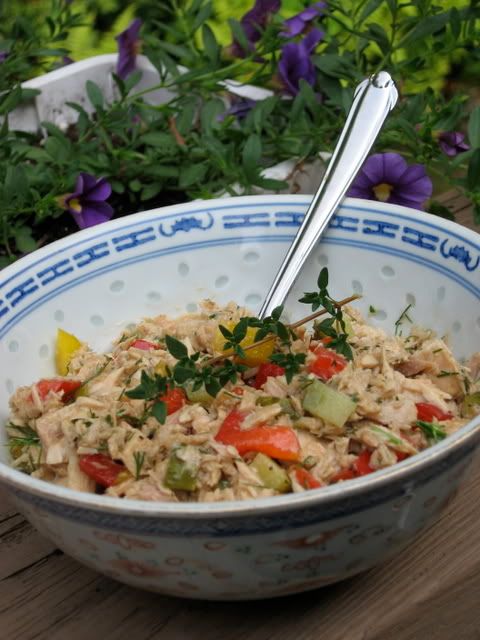
Un-Cooking: Herbed Balsamic Tuna Salad

gluten-free herbed tuna salad
Cooking is the last thing most people want to do when it's 100 degrees farenheit, as it was here yesterday. But we all have to eat, and that's where "un-cooking" comes in. I'm going to try to post a few recipes in the coming weeks for delicious gluten-free meals that can be prepared with no cooking, or with minimal cooking using only a microwave or toaster oven. Meals that won't make your house any hotter than it already is on a mid-summer's afternoon! This here is the first recipe in the series.

This tuna salad is a flavorful twist on an old favorite. It is healthier, lower-cholesterol and more colorful than my other favorite tuna salad which is still my standby. Brightly colored bell peppers are a beautiful and tasty alternative to the usual celery, and a vinaigrette takes the place of mayonnaise - Though adding some mayo will make it creamier, if you prefer. The fresh herbs really shine in this salad, and while I used fresh dill and thyme this time around, I've also used chives and other fresh herbs at other times, so feel free to experiment.

Make sure to use tuna that was not cooked in broth. Check ingredients carefully, because many do contain broth, and it is not always easy to tell if the broth contained gluten as many commercial broths do. Stick to dolphin-safe, low-mercury varieties of tuna for the sake of your own health and the environment.

I enjoy this dish tossed with a green salad, but my favorite way to enjoy it is on toasted Enjoy Life Foods Rye-less Rye Gluten-Free Sandwich Bread, with lettuce from my garden, and a few thick slices of ripe avocado:

tuna salad on gluten-free ryeless rye bread

HERBED BALSAMIC TUNA SALAD

[Gluten-Free / Soy-Free / Nut-Free / Egg-Free / Dairy-Free / Pareve]

2 6-ounce cans of chunk light tuna in water
1/2 cup red and yellow bell peppers, diced finely
1/4 cup kalamata olives, chopped OR 2 small dill pickles, diced
1 Tbsp finely chopped fresh dill
1 Tsp finely chopped fresh thyme
2 Tbsp extra virgin olive oil
2 Tbsp balsamic vinegar
1 Tbsp dijon mustard
Freshly ground pepper (a generous amount)
Optional: 1-2 Tbsp mayonnaise
Optional: 1 Tsp chopped chives

With a fork flake the tuna apart into small pieces. Add all other ingredients. Whisk olive oil, vinegar and dijon mustard (and mayonnaise, if you're using it) together in a small bowl until well-combined and creamy. Pour the dressing over the salad and toss to combine. Add more ground pepper to taste. Serve on top of a green salad or bed of lettuce, or in a sandwich.

This recipe is part of Weekend Herb Blogging, hosted this week by Kalyn's Kitchen.

Wednesday, April 18, 2007

Fried Leeks with Tarragon Vinegar


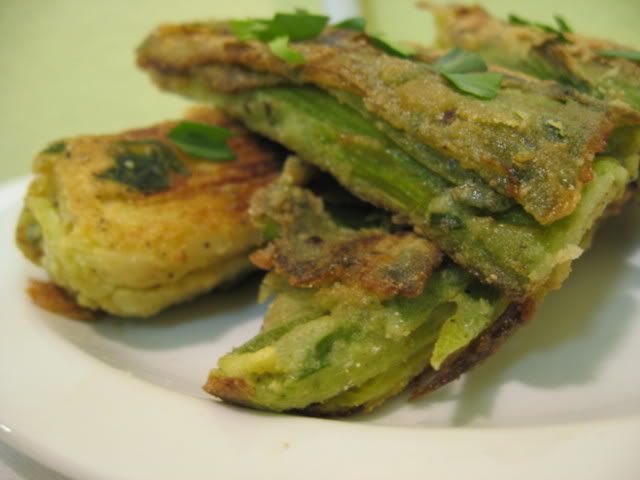
It is no secret that I'm fond of leeks. I use them in place of onions in much of my cooking, and a few months ago I discovered the joys of leek fritters (prassokeftedes) from the Greek Jewish tradition. Delving further into the world of fried leeks, I made a gluten-free adaptation of a wonderful recipe by RecipeZaar user JenPo which is the feature of this post.

I used my Rice Flour Mix as the flour for battering the leeks, but you should be able to use any gluten-free flour mixture that has a fine texture. The recipe calls for tarragon vinegar. You can find an easy recipe for making it at home here or you can buy a premade variety. If you don't have tarragon vinegar on hand, and don't have time to make it, try sprinkling the leeks lightly with chopped fresh tarragon and apple cider vinegar before serving.
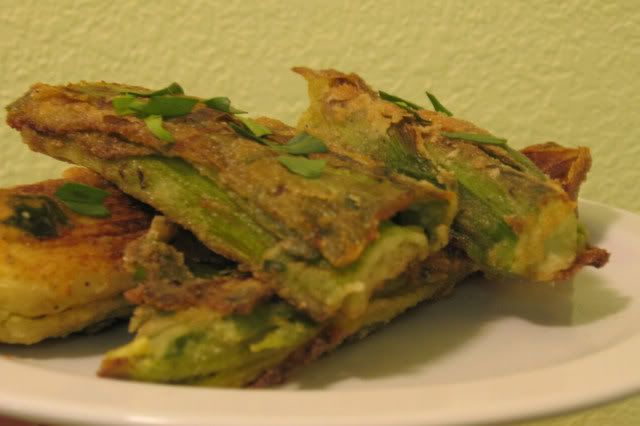
These fried leeks are wonderful - they are sweet and tender, and the batter creates a thin, crispy shell around them. This was my first time cooking with fresh tarragon, which gave me an opportunity to really understand and appreciate the fresh, anise-like taste of this herb. The vinegar was a surprisingly lovely finishing touch to this dish, which is intended to be served as a side dish. I was happy to discover that although they lose some of their crispness, these leeks re-heat well in the toaster oven so leftovers can be refrigerated for a day or two if necessary.

This recipe is part of Weekend Herb Blogging, which is hosted this week by one of my favorite food bloggers, What Did You Eat?

FRIED LEEKS WITH TARRAGON VINEGAR

[ Gluten-Free / Vegetarian / Soy-Free / Dairy-Free / Nut-Free / Parve ]

4 leeks, 1-in thick
2 eggs
Salt and freshly-ground black pepper
1 1/2 tsp fresh tarragon, rinsed and patted dry (or 1/2 teaspoon dry tarragon)
1/2 cup gluten-free flour mix
Olive oil (not extra virgin) or vegetable oil, for frying
2 teaspoons tarragon vinegar

Trim leeks, removing the tougher and darker green part at the top. Slice in 1/2 lengthwise and rinse well to remove sand and dirt. Cut each leek half into 4-inch pieces and do not allow the layers of the leek to separate from eachother. Place in a steamer basket and steam for 10 minutes or until tender. Place on paper towel-lined plate and allow to cool for 20 minutes.

Mince half of the tarragon finely and mix with flour, a generous amount of freshly ground pepper, and salt. Beat the eggs together in a separate bowl.

Heat just enough oil to cover bottom of pan. When the oil is hot, coat the leeks in egg, then in the flour, and then fry until browned, turning frequently. Sprinkle with the tarragon vinegar (or apple cider vinegar) and the rest of the tarragon and serve hot.


Monday, March 19, 2007

Kalamata Olive & Rosemary Bread: The Search for a Gluten-Free Rustic Loaf


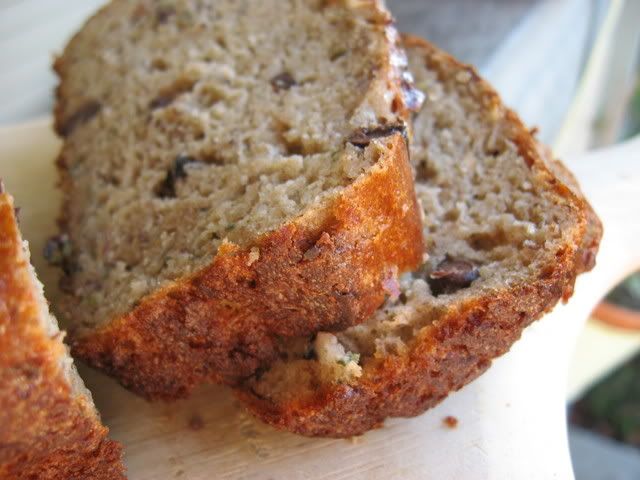
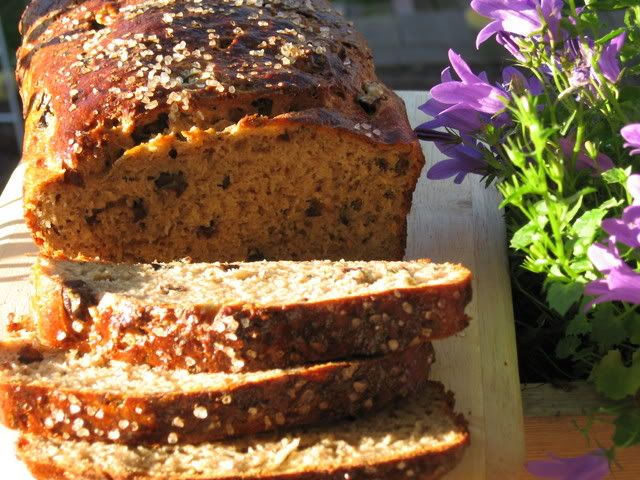
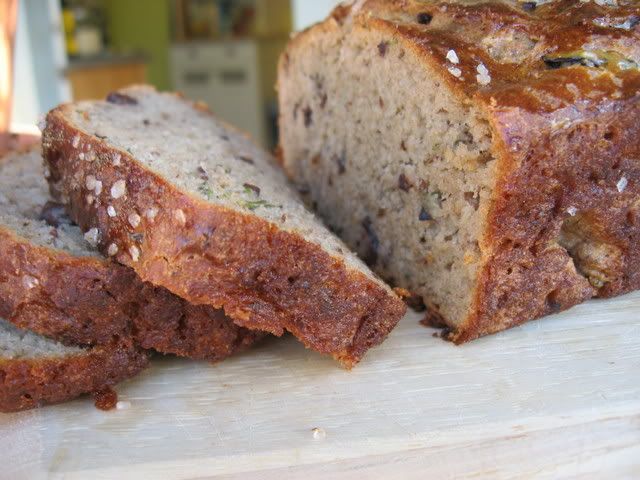
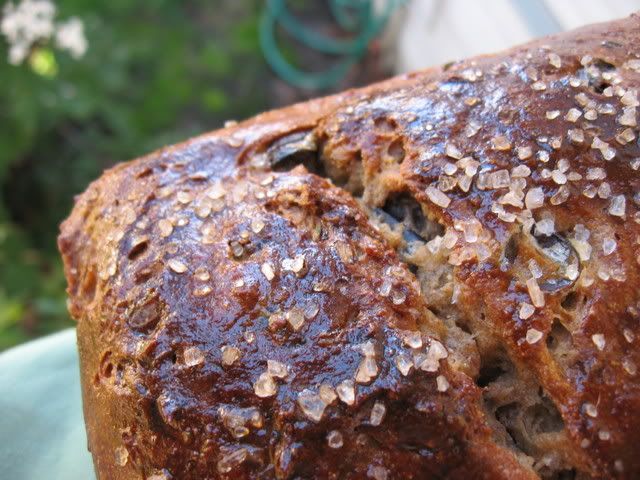
The only thing more comforting than a warm slice of home-baked bread, fresh from the oven? A warm slice of home-baked bread, fresh from the oven, that is infused with rosemary and olive oil and speckled throughout with kalamata olives!

I have been craving a hearty, rustic-style olive bread. Though this recipe did not turn out to be anywhere near as crusty or rustic as the loaves I enjoyed in my gluten-eating artisan-bread-buying days, it certainly turned out wonderfully flavorful. It has the soft, pliable, no-toasting-necessary sandwich bread texture of the Gluten-Free Multigrain Miracle Bread I posted about a few weeks ago, but with a palette of complimentary, savory flavors. Judging by the looks on the faces of the gluten eaters I fed the olive-rosemary bread to, this recipe is a success.

Try this bread with butter on it, or as an accompaniment to Southern European and Mediterranean dishes, or try it with any soup or stew. As for me, I ate the entire loaf (not at once, of course) with hummus on top because I loved how the flavors went together. It would also make a killer grilled cheese sandwich with sharp cheddar.

As for crusty, rustic-style breads - The search continues. I've yet to find a gluten-free recipe that's quite what I'm looking for, but I'll keep working on creating one in my own kitchen. I'm not sure how to describe what I think of as "rustic" bread. I suppose I think of it as heavier, drier, and less glutinous than the breads I usually make. Perhaps cutting down on the xanthan or guar gum (GF gluten replacements) would help. A satisfyingly chewy crust is another element missing from every gluten-free bread I've tasted, no matter how wonderful the taste or texture. So, my esteemed readers, go ahead and enjoy this delicious loaf - but also answer these two questions for me, while you're at it:

1) Do you have any gluten-free bread recipes that yield a "rustic" loaf with a thick or chewy crust?

2) What makes a bread rustic, anyway?

The search continues...


KALAMATA OLIVE AND ROSEMARY BREAD

1/2 cup amaranth flour
1/4 cup garbanzo flour
1/4 cup plus 2 Tbsp white rice flour
5 Tbsp teff flour
1/4 cup tapioca starch
1/4 cup arrowroot powder
2 Tbsp flax seed meal (ground flax seeds)
3 tsp xanthan gum
1 1/2 Tbsp fresh rosemary, finely minced
1/2 cup pitted kalamata olives, chopped roughly
2 tsp active dry yeast
1 tsp salt
2 whole eggs
2 eggs, whites separated from yolks
3/4 cup water, room temperature
5 Tbsp extra virgin olive oil
1 1/2 Tbsp honey
2 tsp apple cider vinegar
Optional: Coarse sea salt crystals for crust

Preheat the oven to 200°F.

Sift the flours, yeast and all other dry ingredients (except coarse sea salt) into a medium bowl. Stir in flax meal and rosemary, and combine.

Combine wet ingredients, including the two whole eggs and the two separated egg whites in a large bowl, using a hand-mixer on low or medium speed. [The two separated egg yolks should be set aside in a small bowl for later use as a glaze]. When fully combined, add kalamata olives. Slowly add dry ingredient mixture and mix with a wooden spoon until fully blended, with no lumps. Scrape the sides regularly.

Grease a 9x5" bread pan, and pour the dough into the pan. Use a spatula or knife to evenly shape the top of the loaf. Cut two diagonal slashes in the top of the loaf. Beat the two separated egg yolks that have been set aside and brush the top of the loaf very lightly with them. Optional: Sprinkle coarse sea salt crystals very sparsely to embellish the loaf.

Turn off the oven and immediately place the pan in it. Do not open the door again, if possible. Allow the dough to rise for 90 minutes. It should rise to the very top of the pan.

Increase heat to 350F and bake for approximately 40 minutes. The crust should be golden-brown. Allow to cool slightly before removing it from the pan to finish cooling. Do not slice until the bread is no longer hot.

This loaf does not need to be frozen, but if there are leftovers after a few days, place slices in airtight bags and freeze.

Thursday, February 15, 2007

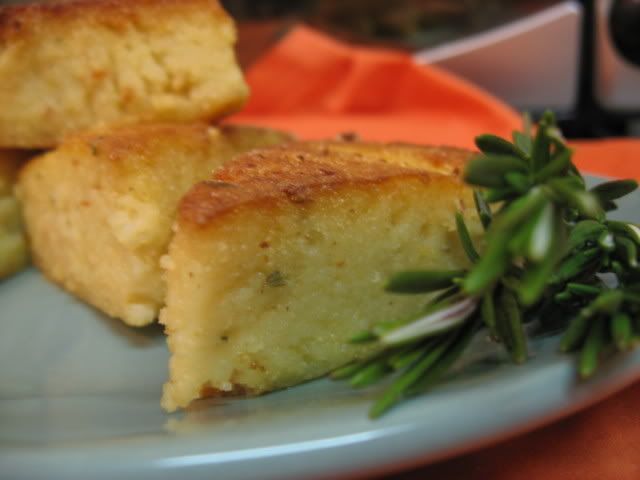
Rosemary Polenta Triangles


I love rosemary and rosemary loves me back. It tastes as good as it smells, and looks as lovely as it tastes. It thrives under the care of the lazy gardener, as it's drought resistant and hardy. I grow it in a pot on my porch, and it valiantly struggles to keep up with rate at which I clip its branches away for my cooking. Weekend Herb Blogging is hosted by a fellow Jewish food blogger this week - The Chocolate Lady of In Mol Araan, who blogs in both Yiddish and English. For this event I chose to adapt a recipe with Italian flavor to be both vegetarian and kosher. In doing so, I was reminded of the long history of Jews in Italy, and a search online brought me a new cookbook to add to my wishlist: Cucina Ebraica: Flavors of the Italian Jewish Kitchen.

This fabulous rosemary-infused polenta recipe is originally from Ina Garten (a/k/a The Barefoot Contessa), one of my favorite TV chefs, whose cooking is normally high fat and far from kosher or vegetarian. While this is not a low-fat dish by any stretch of the imagination, I have managed to reduce the fat content a bit from the original recipe. The transformed recipe turned out to be one of the most delicious incarnations of polenta that I've experienced.

The flour I used to coat the polenta triangles before pan-frying was my Rice Flour Mix, and for vegetable stock I put to use some of the leftover Isaiah's Victorious Vegetable Stock I had in my freezer, which lent an impressive amount of flavor and richness that a storebought broth would lack. This recipe could be easily and deliciously made vegan by substituting margarine (or additional olive oil) for the butter, using an unflavored soy milk as a replacement for milk, and eliminating the cheese.

Though they are terrific all by themselves, I served these tasty triangles on top of a puddle of hot marinara sauce, which was absolutely perfect.


ROSEMARY POLENTA TRIANGLES

5 tablespoons unsalted butter
1/4 cup olive oil
4 cloves minced garlic
1 tsp crushed red pepper flakes
2 tsp finely minced fresh rosemary leaves
1/2 tsp kosher salt
1/2 tsp freshly ground black pepper
3 cups vegetable stock
4 cups milk (whole or 2%)
2 cups cornmeal or instant polenta
1/2 cup grated parmesan or pecorino romano cheese
Gluten-free flour mix
1 tablespoon olive oil, for frying
1 tablespoon butter, for frying

Heat 6 tablespoons of butter and 1/4 cup of olive oil in a medium-sized pot on medium heat. Add the garlic, red pepper flakes, rosemary, salt, and pepper and sauté for 2 minutes. Add the vegetable broth and milk, and bring to a boil.

Remove the pot from the heat and slowly sprinkle the cornmeal or instant polenta into the hot milk while stirring constantly with a whisk. Cook over low heat, stirring constantly, until thickened and bubbly (about 5-10 minutes). For instant polenta, follow the instructions on the package (usually requires only 3 minutes). Remove from heat and stir in cheese.

Pour the polenta into a 9 x 13 x 2-inch pan, smooth the top with a rubber spatula so that it is even, and refrigerate until firm and cold (approximately 1 hour).

Cut the chilled polenta into 12 squares, as if it were brownies. Then carefully lift each square out of the pan with a spatula and cut it diagonally into two triangles. Dust each triangle lightly in gluten-free flour.

Heat 1 tablespoon olive oil and 1 tablespoon butter in a large sauté pan and cook the triangles in batches over medium heat for 3 to 5 minutes, turning once. Cook until browned on the outside and heated throughout. Additional butter and oil may be added as necessary. Serve immediately, alone or with tomato sauce.

Friday, January 19, 2007

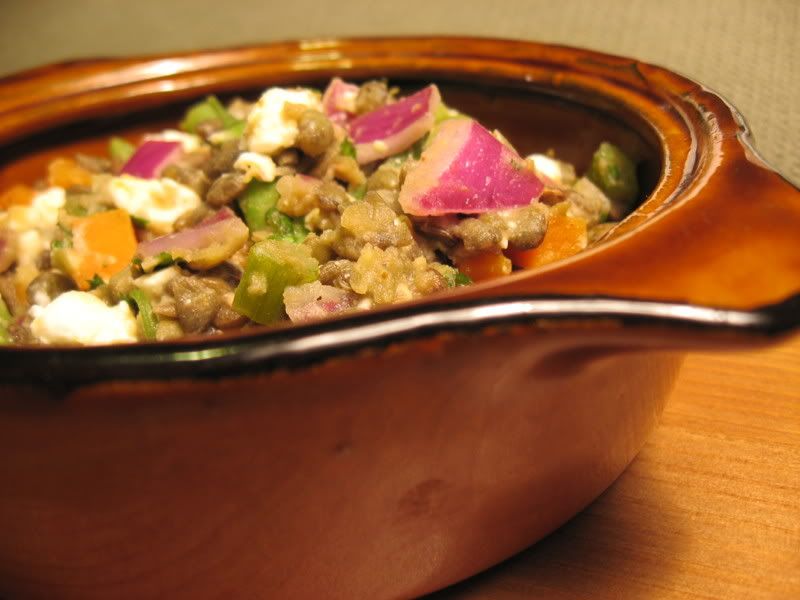
Puy Lentil Salad with Feta


I'm always on the lookout for vegetarian gluten-free recipes that are rich in fiber and protein. This recipe sure meets the requirements, with 11.6 grams of dietary fiber per serving, and 13.6 grams of protein! This is my kosher adaptation of a recipe from user "de Roche" on RecipeZaar - The original called for diced ham.

Puy lentils are a small, flavorful lentil that hold their shape in salads better than brown or red lentils. They are more expensive than other types of lentils but well worth the cost, in my opinion. If you cannot find them, you can substitute beluga lentils, masoor dal, or brown lentils (which won't hold their shape as well as puy lentils). In the picture you can tell that I overcooked them a bit because I forgot to set the kitchen timer... Oops! Thankfully, the salad was still fabulous.

I used Eden Foods' unsweetened Brown Rice Vinegar which is gluten-free, kosher, and organic. You may use a white rice vinegar if that's what you have on hand, and if you prefer you can try one of the "seasoned" rice vinegars which have added sugar.

Use a high quality feta cheese for this salad if you can - It is worth avoiding Athenos or one of the other mass-produced fetas, if possible. I recommend a goat and/or sheep's milk based cheese for the best taste.

PUY LENTIL SALAD WITH FETA

1/2 cup puy lentils
2 bay leaves
1 cup green beans, trimmed and sliced in fourths
1 carrot, peeled and diced
1 stalk celery, diced
2 tablespoons fresh cilantro, finely chopped
1 small red onion, chopped
3 ounces feta, crumbled
2 tablespoons olive oil
2 tablespoons unseasoned rice vinegar
1 teaspoon sea salt
1 teaspoon fresh ground black pepper

Cover the lentils and bay leaves with several inches of water in a saucepan. Bring to a boil, then cover and lower heat. Simmer for 20 minutes or until the lentils are tender. Discard the bay leaf and drain the lentils. Allow them to cool to room temperature.

While the lentils are cooking, chop the beans, carrot, and celery. Steam them for about 5 minutes, or submerge them in boiling water for 1 minutes. They should retain a crisp texture - Do not overcook.

Toss vegetables and lentils together in a bowl. Add cilantro and onion. Combine oil, rice vinegar, salt and pepper. Add dressing to salad and mix well. Stir in crumbled feta right before serving. Serve slightly warm or at room temperature.

Makes 3-4 generous servings.

[Created for Weekend Herb Blogging]

Friday, January 05, 2007

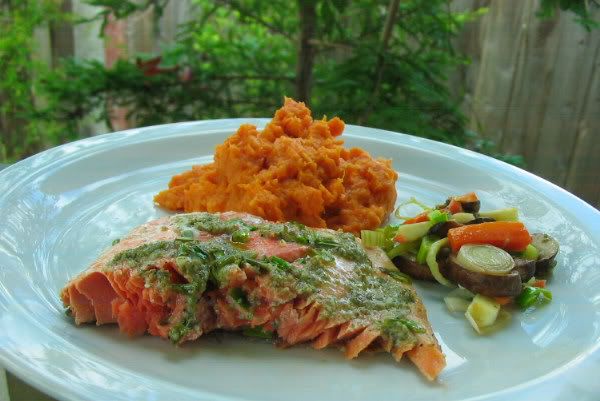
Salmon with Sage and Vegetables in Parchment Paper


Thursday was one of those days when I just didn't want to make a big mess. I was home from work, recuperating from another epidural steroid injection. These procedures cause me a lot of pain for the 2-3 days afterwards, so I was sore and stiff and a little stoned on Tylenol with codeine. But being a blog martyr, I couldn't pass up the opportunity to prepare something delicious for lunch despite being in pain. I based the dish around my limitations (no bending to load or unload the dishwasher, no pulling out kitchen appliances not already on the counter) as well as the two fresh herbs I had on hand: sage and chives. They were starting to go bad and I just can't bear to watch beautiful fresh herbs go to waste. The best motivation of all was my New Year's commitment to participate for the first time in the Weekend Herb Blogging event, hosted this week by the ever-motivated and talented Kalyn.

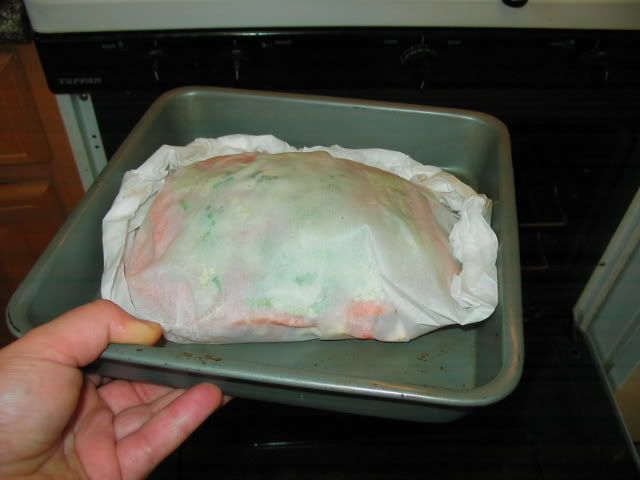
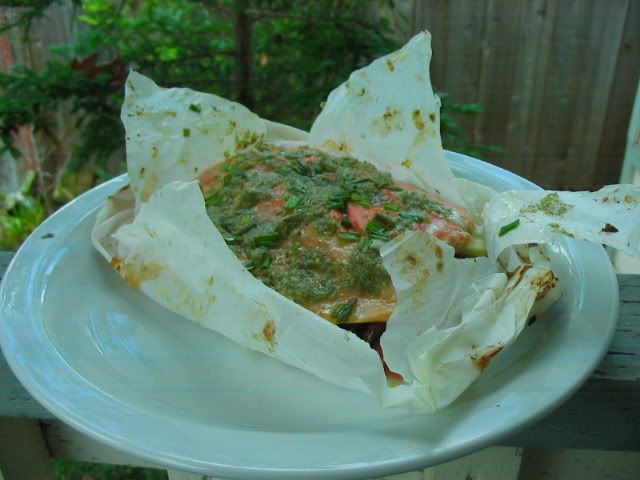
Parchment paper is seriously underrated, my friends. There is a real thrill in a complete meal wrapped up in a little self-contained packet. The joy of pulling out of the oven a perfectly cooked filet of buttery herbed salmon over flavorful vegetables wrapped neatly in a pouch of parchment paper is not so different from the satisfaction of the tasty knishes I posted about in November. Not quite as carb-laden, of course, but still satisfying and aesthetically pleasing.

In the top picture you'll see that I served the fish alongside the vegetables that it was cooked with it, accompanied by a generous portion of Coconut Mashed Yams on the side. You might also try roasting some potato wedges and throwing the parchment-wrapped fish and veggies on top of the potatoes for the last 12-15 minutes of cooking.

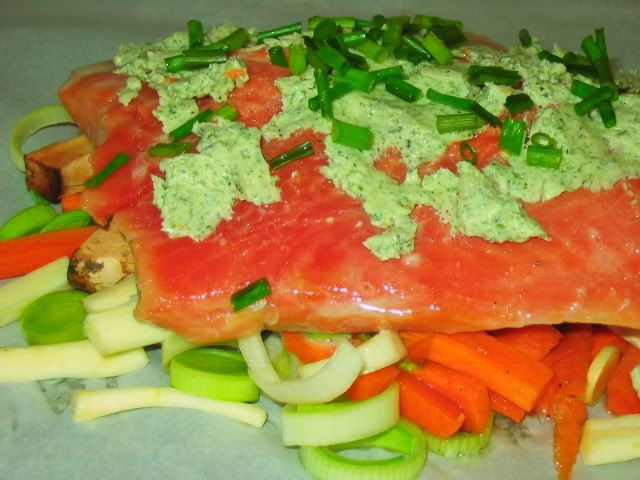
A step by step pictorial:


SALMON WITH SAGE AND VEGETABLES IN PARCHMENT PAPER

1 (8-12 ounce) boneless salmon fillet
1 small leek
1 small carrot
1/2 small parsnip
2 large cremini mushrooms
2 tablespoons unsalted butter, softened
1 fresh garlic clove
1 tablespoon fresh sage leaves (tightly-packed)
1 small lemon, juice of
1/2 teaspoon fresh ground black pepper
1/4 teaspoon salt
2 teaspoons fresh chives, chopped finely
parchment paper (One 15x24 inch piece)
Optional: 1/4 teaspoon thyme, dried or fresh

Preheat oven to 400 degrees F. Cut the tough, darker green tops from the leek and slice the tender lighter-colored section into very thin rounds. Cut (julienne) carrot and parsnip into matchsticks approximately 1/2 inch long and 1/4 inch wide. Slice crimini mushrooms in half lengthwise and then into 1/4 inch slices.

Combine butter, lemon juice, thyme, sage, pepper and salt in a food processor and pulse until thoroughly pureed.

Mix vegetables together. Lay them in a nest about the size of the salmon filet on one side of the parchment paper. Place 1/3 of the sage-butter mixture on top of the vegetables.

Place salmon on top of vegetables and spread with the rest of the sage-butter mixture. Sprinkle chopped chives on top, distributing evenly. Fold the other side of the parchment paper over on top of the salmon. Roll and crimp edges together to create a tightly-sealed half-moon shaped packet. Place packet on baking sheet and bake for 12-15 minutes. Remove from oven and allow to sit for 5 minutes.

To serve, place the packet on a dinner plate and create two slashes on the top of the paper in the shape of an X with a sharp knife. Peel back paper and enjoy. Alternately, you can cut the salmon into 2-3 pieces and place on individual plates next to a generous spoonful of the vegetables.